
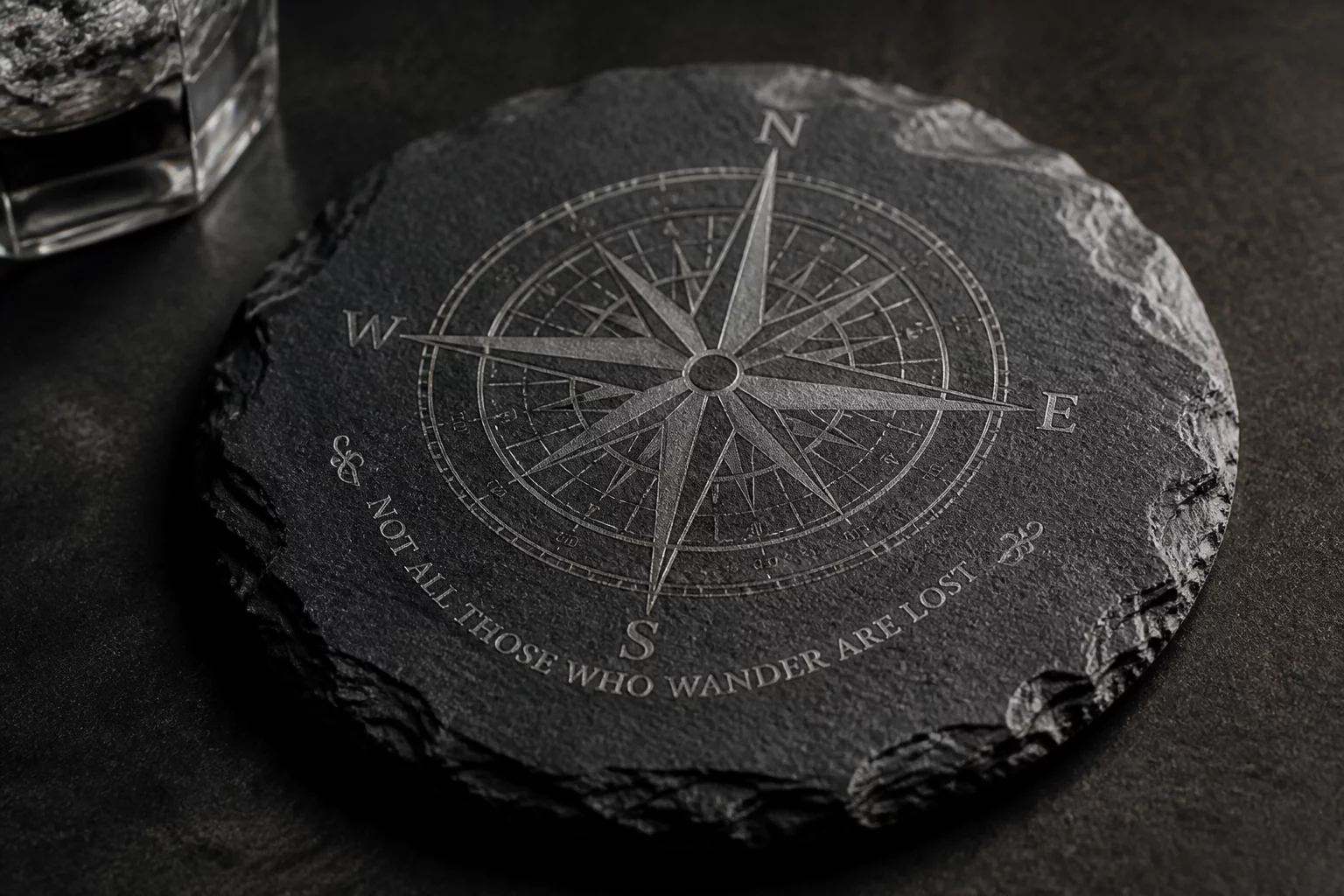
Natural Stone Substrate Dynamics & Beam Absorption
Natural metamorphic slate presents unique challenges for laser operators due to uneven cleft textures and layered mineral grain. Unlike homogeneous acrylics or organic wood veneers, slate responds to focused laser energy not through vaporization or combustion, but via localized thermal micro-fracturing. The concentrated thermal shock cleaves microscopic layers off the silica-rich matrix, creating a bright frosted finish that contrasts vividly against dark unengraved stone. Understanding this mineral reaction prevents over-powering the beam, which risks deep spalling rather than crisp legible marking.
Variations in stone density and natural quarry variations mean focal distance must be calibrated across the entire fixture bed. When running high-volume coaster batches, operators must account for uneven coaster thickness, which commonly fluctuates between 4mm and 7mm across a single batch. Utilizing a slightly wider focal beam depth or a longer focal lens (such as a 2.5-inch lens) minimizes depth-of-field sensitivity, ensuring uniform mark whiteness from edge to edge across every coaster placed in the jig.
Focal Calibration & Surface Hatching Sequence
The layer sequence for slate processing requires precise ordering: boundary alignment framing must precede all raster passes, followed by line-fill engraving, and concluded with fine vector contour scoring if vector definition is needed. Executing the hatch pattern in bidirectional passes with low line intervals produces a continuous frosted texture without dark vertical banding:
- Initial Alignment & Substrate Leveling: Verify physical surface height across all coaster corners using stepped gauge blocks to prevent focal drift.
- High-Speed Unidirectional or Cross-Hatch Raster: Run engraving passes between 250–400 mm/s at 18–25% power (CO2 60W reference) at 0.08mm line interval.
- Low-Pressure Air Assist Sweep: Maintain minimal positive air pressure to clear expelled mineral dust without cooling the localized beam impingement zone.
Excessive laser energy results in scorched brownish edges or thermal spalling, where chunks of the slate flake off unpredictably. If higher contrast is desired, lowering the speed while decreasing peak power delivers far crisper edge resolution than pushing peak wattage. Always test a non-critical border region before running multi-piece commemorative sets.
Post-Processing & Environmental Sealing Verification
Following laser execution, fine stone particulate settles into the etched micro-grooves. Rinse the coaster under running water or clean with a soft nylon brush and isopropyl alcohol to clear away loose mineral debris, restoring high-contrast white definition. For liquid-resistant barware applications, applying a thin coat of food-grade mineral oil or matte acrylic sealant darkens the raw background stone while preserving the bright frosted engraving.