
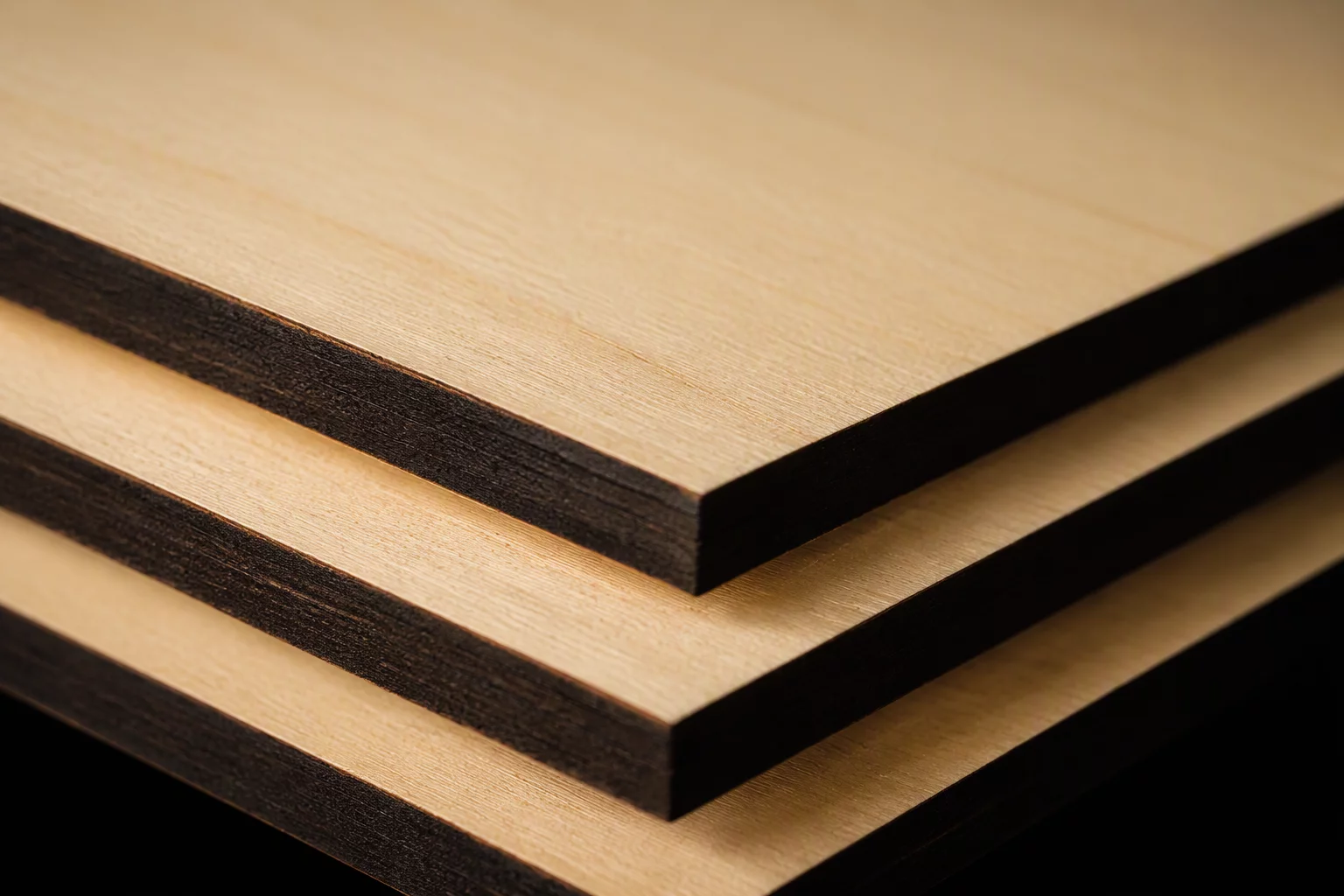
Material Composition & Kerf Compensation
Birch plywood 3mm is widely regarded as the reference standard for precision laser fabrication due to its high core density, fine grain, and dimensional consistency across multi-ply veneers. Unlike soft plywoods, Baltic birch consists of three equal-thickness birch plies bound with thermosetting resins, ensuring uniform laser beam resistance across the entire cutting path.
To achieve tight press-fit joinery and interlocking slot dimensions, operators must account for a mean beam kerf of 0.18 mm when focusing with a standard 50.8 mm (2.0 inch) focal lens. Setting up dedicated offset vectors or utilizing software kerf compensation keeps tabs secure without glue. Variations in moisture content or localized glue pockets require consistent air assist pressure to ensure complete cut-through without excessive perimeter scorching.
Three-Tier Layer Run Hierarchy
Processing 3mm birch plywood requires strict adherence to operational order. Cutting the exterior outline prematurely causes individual components to tilt or drop into the honeycomb bed, instantly losing laser focus for any internal features or surface markings.
- Layer 00 (Engraving & Marking): Execute high-speed raster engraving and low-power vector scoring while the sheet maintains rigid mechanical registration against bed pins.
- Layer 01 (Internal Geometry): Process inner cutouts, alignment pin holes, and fine structural slots before any boundary separation occurs.
- Layer 02 (Outer Perimeter Cut): Cut the perimeter boundary last, allowing the finished part to release cleanly without disturbing adjoining geometries.
Grouping vectors strictly by layer sequence rather than spatial coordinates eliminates toolpath drift. When cutting extensive nested layouts, organize parts from the center of the bed outward to maintain overall sheet tension and prevent thermal warp lifting.
Smoke Evacuation & Output Quality
Surface discoloration on 3mm birch plywood results from resin condensation settling back onto the veneer. Employing a clean conical air assist nozzle at 2.0 to 2.5 bar drives vaporized lignin straight through the cut channel into the downdraft exhaust plenum. Masking the top surface with low-tack paper tape yields pristine, bright edges requiring zero post-run sanding.