
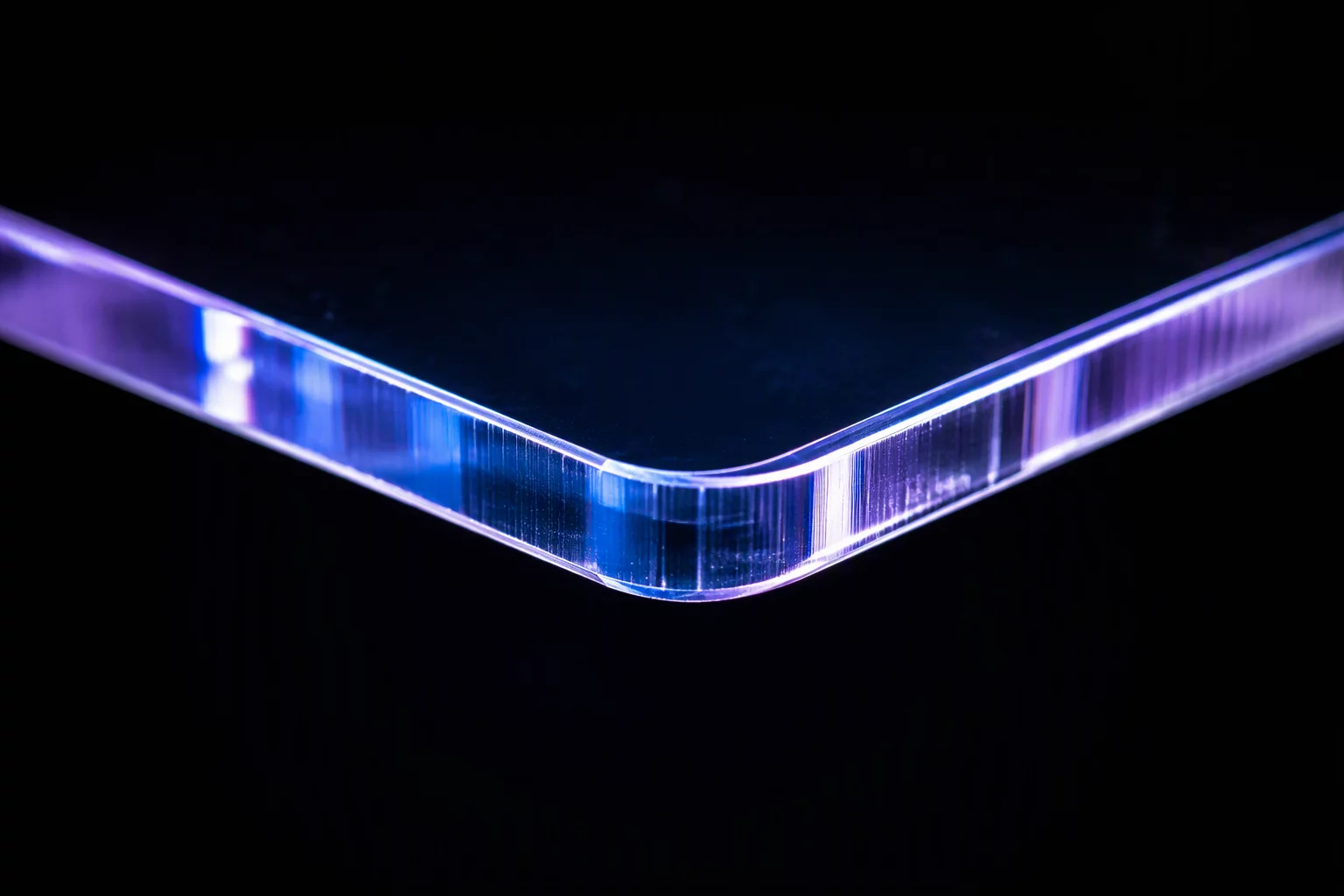
Material Behavior & Cast PMMA Physics
Cast acrylic (polymethyl methacrylate or PMMA) responds to laser radiation by direct thermal depolymerization into monomer vapor rather than liquid melt slag. When cutting 3mm cast sheets, this chemical transition produces the characteristic flame-polished edge that makes acrylic a cornerstone of precision fabrication. Unlike extruded grades, cast acrylic exhibits superior optical clarity, minimal stress cracking during vector profiling, and yields a uniform frosted white contrast when subjected to raster engraving.
Achieving optical perfection requires balancing power density against thermal residence time. Excessive power at low velocities causes vapor ignition and edge bulging, while insufficient thermal input leaves striations along the cut profile. Because cast acrylic sheets have a thickness variation tolerance of roughly ±10%, focal positioning must target the mid-plane (1.5mm below top surface) rather than the extreme top boundary to equalize beam waist divergence across the entire cut depth.
Parameter Calibration & Toolpath Order
Executing clean profiles in 3mm acrylic demands a strictly ordered layer sequence. Always perform internal pocket engraving and detail scoring before executing the perimeter vector cut, ensuring the parent sheet remains completely stationary and flat against the support bed throughout the high-energy passes:
- Engrave & Score Stage: Low power, high speed rastering with paper masking intact to prevent vapor halo redeposition across polished surfaces.
- Internal Cavity Profiling: Vector cuts on interior dropouts using gentle air assist to clear gaseous monomers without chilling the molten boundary prematurely.
- Outer Perimeter Isolation: Single-pass perimeter cutting calibrated with optimal focal offset to ensure total part separation without mechanical wedging.
Air assist regulation is particularly nuanced on acrylic compared to wood or metal. Heavy air pressure violently quenches the molten kerf wall, creating frosted micro-cracks and rough vertical ripples. Conversely, insufficient extraction risks ignition of methyl methacrylate vapors. Setting a low, continuous laminar airflow keeps the optical path clear while letting the laser beam naturally glaze the edges glassy smooth.
Verification & Edge Inspection
Post-process inspection focuses on vertical edge squareness, the absence of corner melt-rounding, and clean dropout release. Verify that no monomer re-welding has occurred at sharp interior vertices. When peeling protective paper, observe whether adhesive residue remains softened by heat; a properly tuned speed-to-power ratio leaves paper adhesive intact without heat scorched margins.