
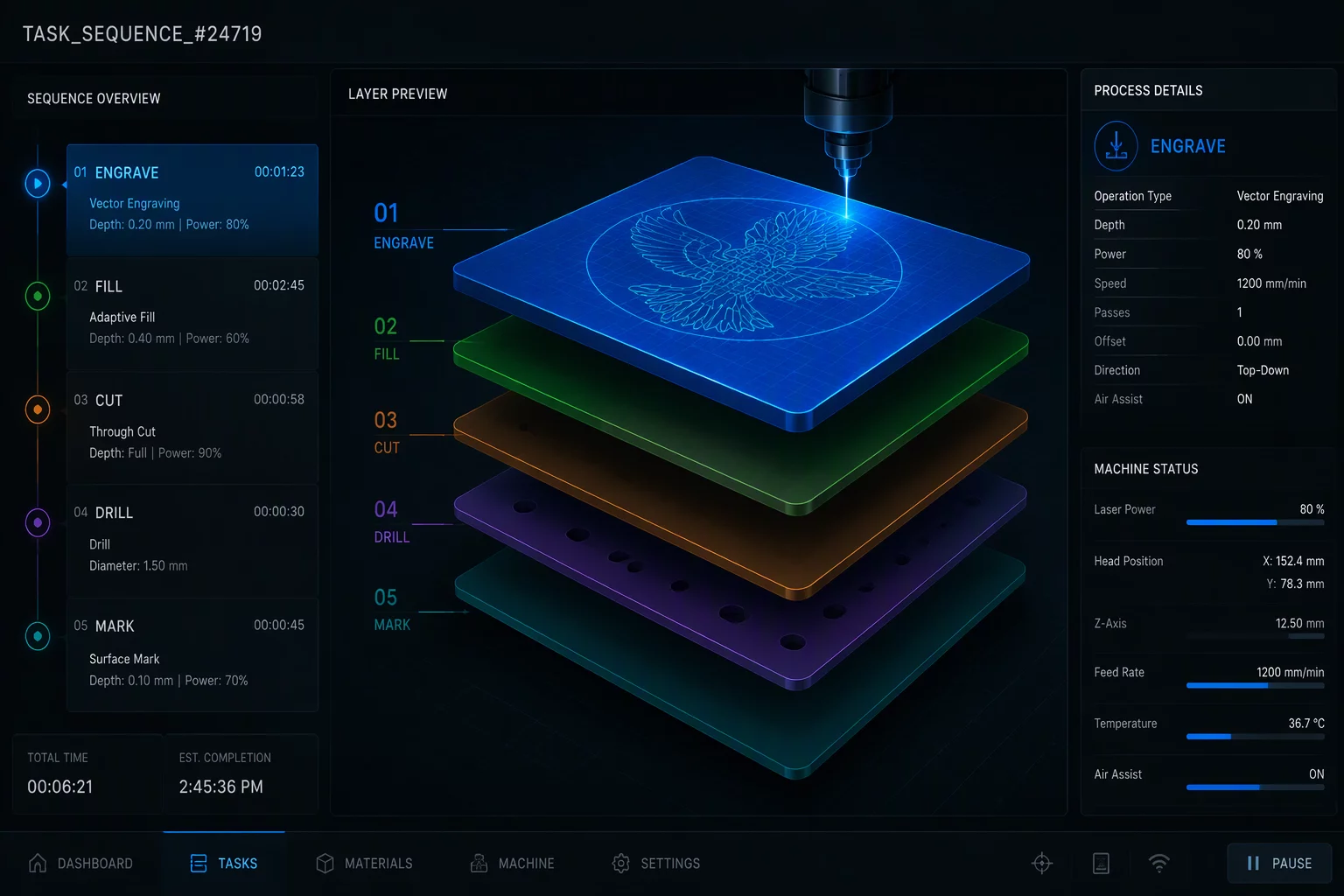
Mechanical Stability and Material Integrity
In precision laser machining, substrate immobility dictates output quality. High-speed bidirectional engraving heads exert aerodynamic and mechanical vibration across the honeycombed bed. Performing surface rastering while parts remain firmly attached to the surrounding frame prevents tiny components from tipping, vibrating out of alignment, or dropping into the exhaust chute.
When a perimeter cut occurs prematurely, the detached workpiece rests solely on bed pins or honeycomb cells. Subsequent raster passes over this loose geometry will drag smoke debris across fresh edges, trigger micro-shifts during rapid raster direction changes, and compromise registration with subsequent passes.
Raster vs. Vector Execution Order
LightBurn and industrial DSP controllers process operations based on prioritized layer ordering. Setting black and blue raster layers ahead of red vector cuts establishes an automated safeguard for complex multi-operation jobs.
- Step 1: Broad Surface Fill & Texture (High speed, moderate power, minimal assist air).
- Step 2: Fine Detail Scoring & Vector Markings (Fast vector travel for crisp perimeter lines).
- Step 3: Perimeter Geometry & Internal Cutouts (Full beam penetration, high air assist).
Grouping geometries without layer-level sequence awareness frequently triggers accidental out-of-order operations. Always verify the Layer Stack sequence from top to bottom before sending the G-code or RD file to the laser gantry.
Focus Retention and Kerf Management
Simulating the run through the preview module verifies that the laser head concludes all high-density rastering before puncturing through the final bounding contours. This verification is intended to help zero kerf distortion and perfect geometric alignment across your entire run.